
Chipboard Panels: Thickness Options and Where They Fit
Particle board is pressed from wood particles and resin, and its published range runs from 8 mm to 18 mm across six thickness options on 1220 × 2440 mm sheets, with customised sizes available. It is a workhorse panel rather than a specialist one: furniture, interior panels, door cores and flooring substrates all appear on the application list. Thickness is the decision that carries the most weight, because the same material is doing very different jobs at 8 mm and at 18 mm.

Key takeaways
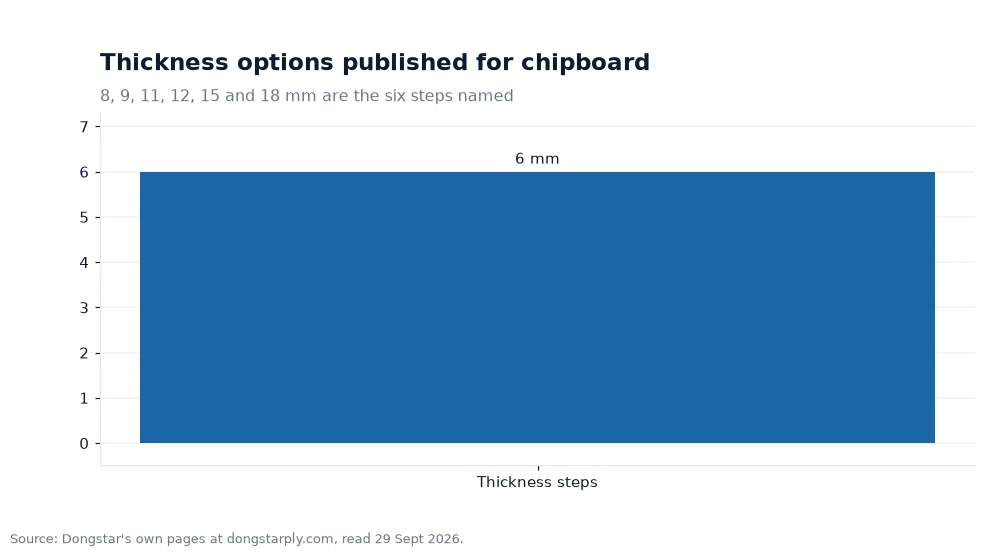
- The published thickness range covers six steps from 8 mm to 18 mm on 1220 × 2440 mm sheets, and customised sizes can be quoted on request.
- The board is defined as wood particles bonded with synthetic resin, and the particle mix includes wood chips, sawmill shavings and other wood residues.
- Three core species are named — poplar, pine and eucalyptus — and nine resin options run from MR and the E-classes through to PMDI, WBP and phenolic.
- The application list is interior-focused: furniture, decorative panels, doors and door cores, and substrates for laminate or engineered flooring.
What the panel is made of, in the mill's own words
The published definition is short and worth reading literally: wood particles bonded together with synthetic resin. The particle mix is described as wood chips, sawmill shavings and other wood residues, which is the detail that explains how the material behaves. Mixed particle sizes press into a dense, uniform sheet with no grain direction to work around, and that uniformity is why the panel machines and routs predictably.
It also explains the two things buyers should test rather than assume. Screw holding depends on the density near the face, and density depends on how the mat was formed and pressed. Edge quality depends on the same thing. Neither property appears on a one-line quotation, so both belong in the questions asked before the order leaves the desk.
Six thickness steps and the sizes that travel with them
The datasheet window is 8 mm to 18 mm in six steps, on 1220 × 2440 mm sheets, with customised sizes offered alongside. Thin panels in the 8 mm to 12 mm range suit linings, cabinet backs and lightweight components where the panel is supported by a frame or a substrate. The 15 mm and 18 mm steps carry heavier furniture components, worktops with a supporting structure, and door cores that need thickness for hardware.
Nothing about the format is unusual, which is precisely why it is useful: the sheet fits standard container loading, standard panel saws and standard edge-banding equipment. A buyer switching suppliers does not have to rebuild a cutting plan, and a distributor can hold one format across several product families.
Cores and resins on the same line of the datasheet
Poplar, pine and eucalyptus are the three core species named, and each brings a different balance of weight and workability to the finished sheet. Alongside them sits a resin list that is longer than most buyers expect: nine adhesive systems: MR, E2, E1, E0, ENF, PMDI, WBP, melamine and phenolic.
Those names split into two groups. MR, WBP, phenolic and melamine speak to moisture behaviour, while E2, E1, E0 and ENF are formaldehyde release labels, with E2 the higher of the emission classes and E0 and ENF at the lower end. Sorting the list that way before writing an enquiry removes most of the confusion, because a specification rarely needs more than one name from each group.
Where chipboard earns its place in a project
The application list published for Chipboard Particle Board opens with furniture manufacturing, where the panel works as a stable and economical alternative to solid timber. Cabinets, shelves and carcasses that will be faced, edged or veneered do not need solid wood inside, and a uniform core keeps dimensions steady as humidity moves through the seasons.
Three further uses are named. Interior design and decorative panels cover wall panels, ceilings, partitions and decorative screens. Doors and door cores take advantage of the flat, dense sheet, which machines cleanly for hardware and laminating. Flooring systems use the panel as a substrate under laminate or engineered wood flooring, where a level, uniform base decides how the finished floor feels underfoot.
Where the panel needs a different answer
Almost everything on the published application list sits indoors. That is not a limitation to apologise for; it is the boundary of the product, and projects that cross it should be discussed with the mill rather than assumed. Roof decks, exterior cladding and floors that stay wet during construction are not interior furniture work, and the resin question changes shape entirely in those conditions.
The practical test is simple. If the finished component will live inside a building that is heated, ventilated or otherwise protected, chipboard is usually the economical answer, and the specification work is about thickness, core species and emission class. If it will not, the enquiry needs to say so in the first sentence, because the answer will be a different panel family altogether.
| Field | Published value | What it decides |
|---|---|---|
| Panel size | 1220 × 2440 mm, customised | Cutting yield, container fill and equipment compatibility |
| Thickness | 8, 9, 11, 12, 15, 18 mm | Whether the panel lines, faces or carries a component |
| Core species | Poplar, pine, eucalyptus | Panel weight, density and how the edge machines |
| Resin | MR, E2, E1, E0, ENF, PMDI, WBP, melamine, phenolic | Moisture behaviour and formaldehyde emission class |
| Applications | Furniture, interior and decorative panels, doors and door cores, flooring substrates | Whether the job is inside the published scope |
Worked example: sizing an 8 mm flooring substrate order
A fitter has 120 m² of laminate flooring to lay over a particle board substrate, and experience says to allow 8% for cutting waste. The area to buy is therefore 120 × 1.08 = 129.6 m² (example arithmetic). One 1220 × 2440 mm sheet covers 1.22 × 2.44 = 2.9768 m², so 129.6 ÷ 2.9768 = 43.5 sheets, which rounds up to 44 sheets (example).
The thickness change then alters only the cube, not the area. If the same 44 sheets are taken in 18 mm instead of 8 mm, each sheet occupies 2.9768 × 0.018 = 0.0536 m³, giving 2.36 m³ in total, against 2.9768 × 0.008 = 0.0238 m³ per sheet and 1.05 m³ overall at 8 mm (example). The area delivered is identical — roughly 131 m² either way — but the freight and handling effort is not, which is why the substrate thickness belongs in the transport conversation rather than only in the joinery one.
Frequently asked questions
Is chipboard the same as particle board?
Yes. The two names describe the same material: wood particles — wood chips, sawmill shavings and other wood residues — bonded with synthetic resin and pressed into a sheet.
Which thickness should be used for furniture carcasses?
Most carcass work sits at the thicker end of the published range, where 15 mm and 18 mm give hardware enough material to hold. The thinner 8 mm to 12 mm steps are better suited to backs, linings and components that a frame will support.
Can the panel be used in a wet area?
The published application list is interior-focused, and the resin options that speak to moisture — MR, WBP, melamine and phenolic — should be raised with the mill for any damp service. Exterior and permanently wet applications fall outside the listed uses.
Continuing to the faced versions
Most chipboard leaves the factory to be covered, and the surface story continues on the faced panel pages, where cores are listed for the decorative laminate range. Buyers who want to see the whole family before choosing a core can start from the wood panel group listing.
Panel dimensions, thickness steps, core species and resin names are quoted from the maker's own website, read on 29 September 2026, and used throughout these notes, as quoted in the chart above[1].