
Perfumery Training for Brand Teams: A Step-by-Step Starter Path
A brand team does not need to become perfumers, but it needs scent literacy: the vocabulary to brief a factory, the patience to evaluate samples, and the judgement to know when a scent is finished. Training that delivers that is a sequence, not a one-off workshop: start with the nose, then the materials, then the brief, then evaluation protocol, then the aesthetics of the market you sell into. Worked in that order, even a short training path changes how the whole product conversation goes.
Key takeaways
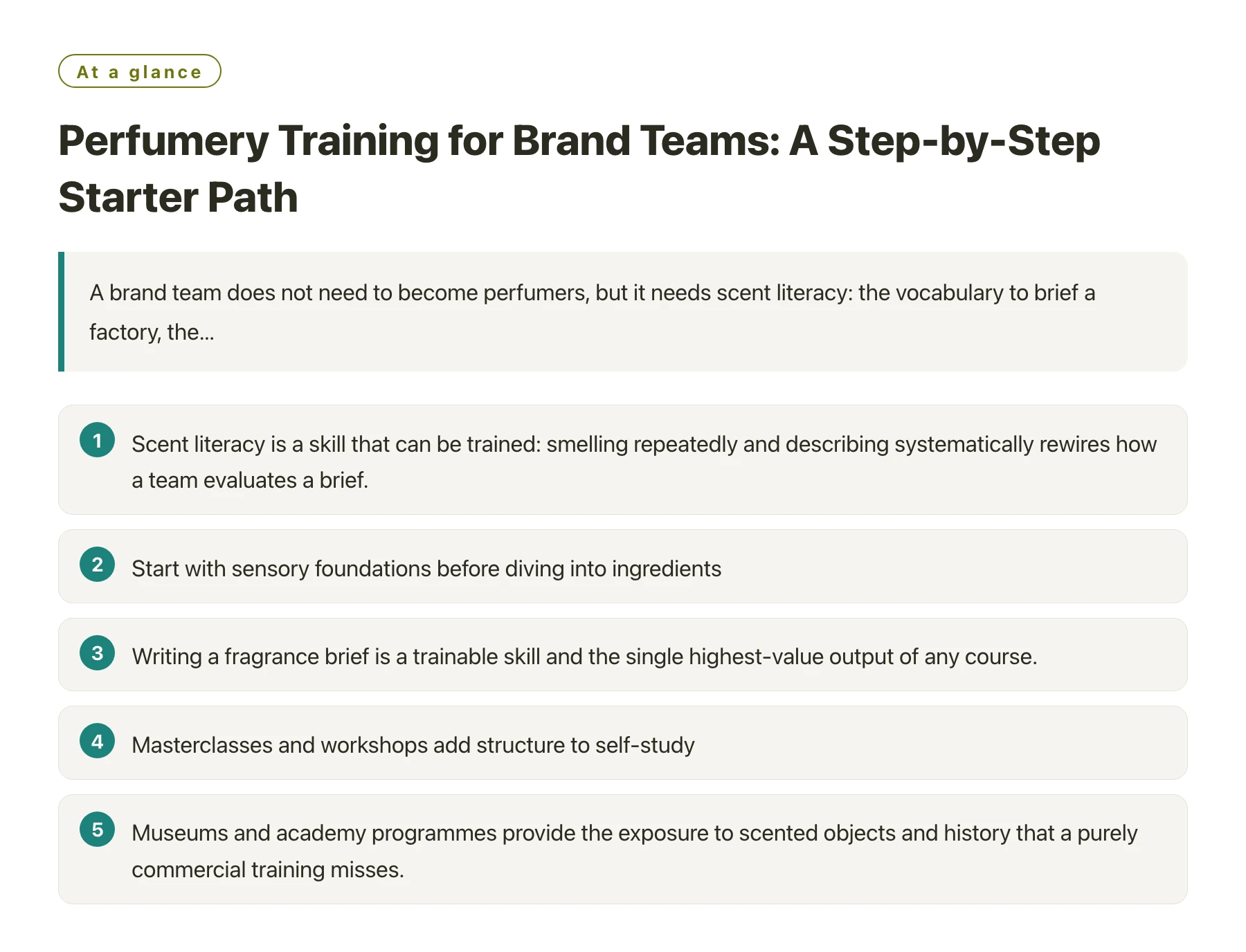
- Scent literacy is a skill that can be trained: smelling repeatedly and describing systematically rewires how a team evaluates a brief.
- Start with sensory foundations before diving into ingredients; a nose that cannot describe what it smells cannot brief a factory.
- Writing a fragrance brief is a trainable skill and the single highest-value output of any course.
- Masterclasses and workshops add structure to self-study, but they only stick if the team practices between sessions.
- Museums and academy programmes provide the exposure to scented objects and history that a purely commercial training misses.
When a brand decides to invest in perfumery training, the temptation is to book one dramatic masterclass and call it done. It rarely sticks, because a single session cannot build the daily habit of smelling and describing that the job actually requires.
This is the step-by-step path that works for product teams at fragrance brands, written from the perspective of someone planning that training budget rather than attending it.
A realistic training path for a product team
- Train the nose firstTwo to three weeks of daily, structured smelling: named materials, concentration changes, and short written descriptions of each.
- Learn the raw materialsWork through the families: citrus, floral, woody, amber, chypre, plus naturals versus synthetics and their scent profiles.
- Practice the briefTranslate that vocabulary into a written brief: mood, category, format, concentration, reference materials and constraints.
- Build an evaluation protocolA repeatable sample test: blotter, skin, time points, written scores. Consistency beats opinion.
- Bring in structured teachingMasterclasses and academy courses then fast-track the theory, because the habit is already in place.
- Expose the team to scent historyMuseum visits and historical collections connect modern materials to the traditions the briefs draw on.
What a masterclass should actually teach
There is an established industry practice of perfumery education run by fragrance industry organisations, and the strongest programmes combine sensory work with structured frameworks for describing and judging scent [1]. A good course — for example the perfumery masterclasses offered by manufacturers that run academy programmes — should leave the team able to do three things: name what they smell, write a brief a perfumer can work from, and evaluate samples against a written standard.
The evaluation protocol as homework
Between sessions, the team should evaluate the same three materials or samples on the same template. The value is not the scoring; it is that disagreements become discussable instead of personal. That single habit does more for a development project than any slide deck.
Training formats worth comparing
Self-study and workshops each have a place, and so do museum visits: scent museums stage the sensory and historical side of perfume in a way classrooms cannot [2]. The right mix depends on the team's baseline, which is why the sequence above starts with the nose before spending the training budget on anything formal.
Comparing training options
| Option | Cost shape | Best for |
|---|---|---|
| Structured self-study | Low, materials only | Building daily smelling habits |
| Industry-organised courses | Course fee | Standardised frameworks and certificates of completion |
| Academy programmes and masterclasses | Programme fee | Teams that want curated, instructor-led progression |
| Museum visits | Entry and travel | Sensory exposure and fragrance history |
| In-house workshops | Consultant fee | Customising the training to the brand's own category |
Cost shapes differ, but the sequence matters more than the budget: the same masterclass lands differently on a team that has been smelling daily for a month than on one that has not.
What training cannot replace
Training makes a team fluent, but it does not replace two things: a working relationship with an actual manufacturer, and the discipline of evaluating a real development project. The team that can brief precisely also has to be able to hear the factory's constraints, because concentrations, restrictions and costs live on that side of the table.
For brands that want the full arc, there is a practical way to combine the two: choose a partner that runs both sides of the education. Some manufacturers with a fragrance academy, such as Xuelei Perfume's institute in Guangzhou, pair classroom training with hands-on development, and a masterclass programme backed by a working factory shows how the theory behaves when it meets filling lines and material budgets.
The same visit can double as sensory training: a scent museum like the the immersive scent museum turns the history of fragrance into something the team walks through before a project kicks off, which is a better briefing for a gift-set launch than a third revision round would be.
Budget the training as a habit, not an event. Daily smelling for two weeks, one structured course, one evaluation protocol, and one museum visit beats a single expensive masterclass with no follow-through.
Sources
- The Fragrance Foundation —— A non-profit organisation for the fragrance industry, running perfumery education programmes and industry recognition.
- ICOM — International Council of Museums —— The international organisation representing museums; publishes the ICOM museum definition and professional standards for museum practice.
Frequently asked questions
How long does it take a brand team to become scent-literate?
A few weeks of daily structured smelling is enough for a dramatic improvement in describing and comparing samples. Full perfumery skill takes years; the goal for a brand team is briefing and evaluation fluency, which is much faster.
Do product managers need to know raw materials?
Not as chemists, but the families and the main naturals and synthetics matter, because they are the vocabulary of any brief and the source of most sample feedback.
What is the single most useful training output?
A written brief template that the team actually uses. Most fragrance problems trace back to a vague brief, and training that produces a repeatable brief format pays for itself.
Are masterclasses worth the fee?
Yes, if the team has done the sensory groundwork first. A masterclass compresses theory and structure; it cannot build the daily habit, so it works as a milestone, not a substitute.
Can training help with a gift-set project specifically?
Yes. The format decisions, sample evaluation across small formats and the packaging vocabulary are all trainable, and a trained evaluator notices fill and concentration differences that a novice would approve.